Developing UX maturity in a founder-led fin-tech
Design leadershop
Client
Finder.com.au
Services
Design leadershop
Year
2023
Background
Finder is a founder lead, global business that helps users save money by comparing products and services from a variety of industries including home loans, insurance and credit cards. They also offer a finance management app to members to help them monitor their finances, track spending and investments. Over the last five years the business invested heavily into offering crypto trading and staking products. Following the implosion of crypto in 2023, Finder withdraw all crypto products from their offerings.
Understanding the problem
To this day the business is founder lead (CEO, CPO, COO). There are many positives in having a founder lead business, the downside is the lack of executive exposure to common product processes and having a solid understanding of the value design can drive, beyond surface level UI.
As part of my first 100 Day plan I set about understanding the culture and processes that drive product decisions. Through qualitative research, which involved speaking to 30+ stakeholders, and quantitative surveys the following themes emerged:
Customer insights were not an integral consideration in product strategy or planning
Across business units there was a limited understanding of what UX design is and the value it can deliver
Low UX proficiency amongst the product design team was leading to a misconception around the insights and strategy value product design can deliver
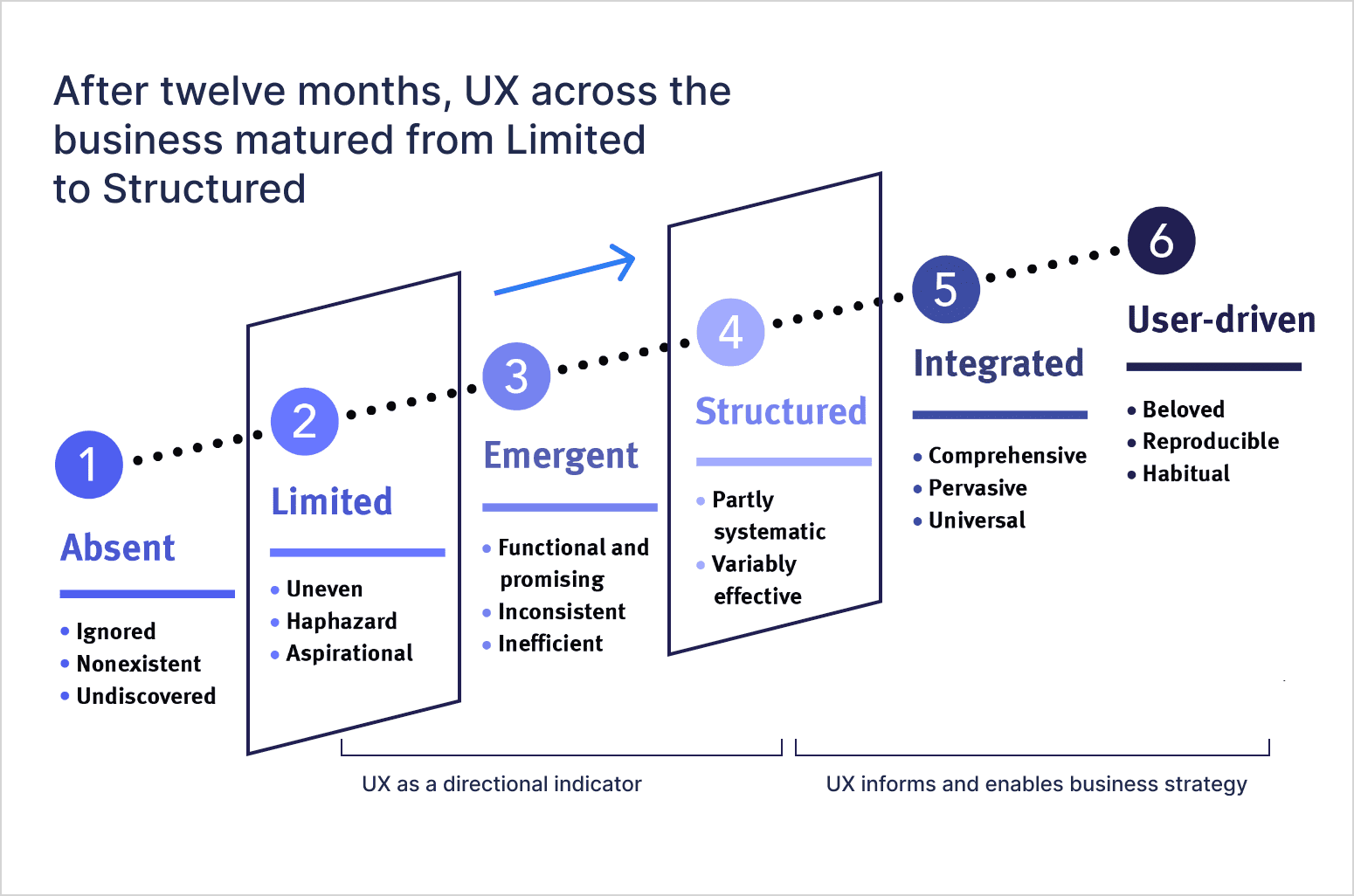
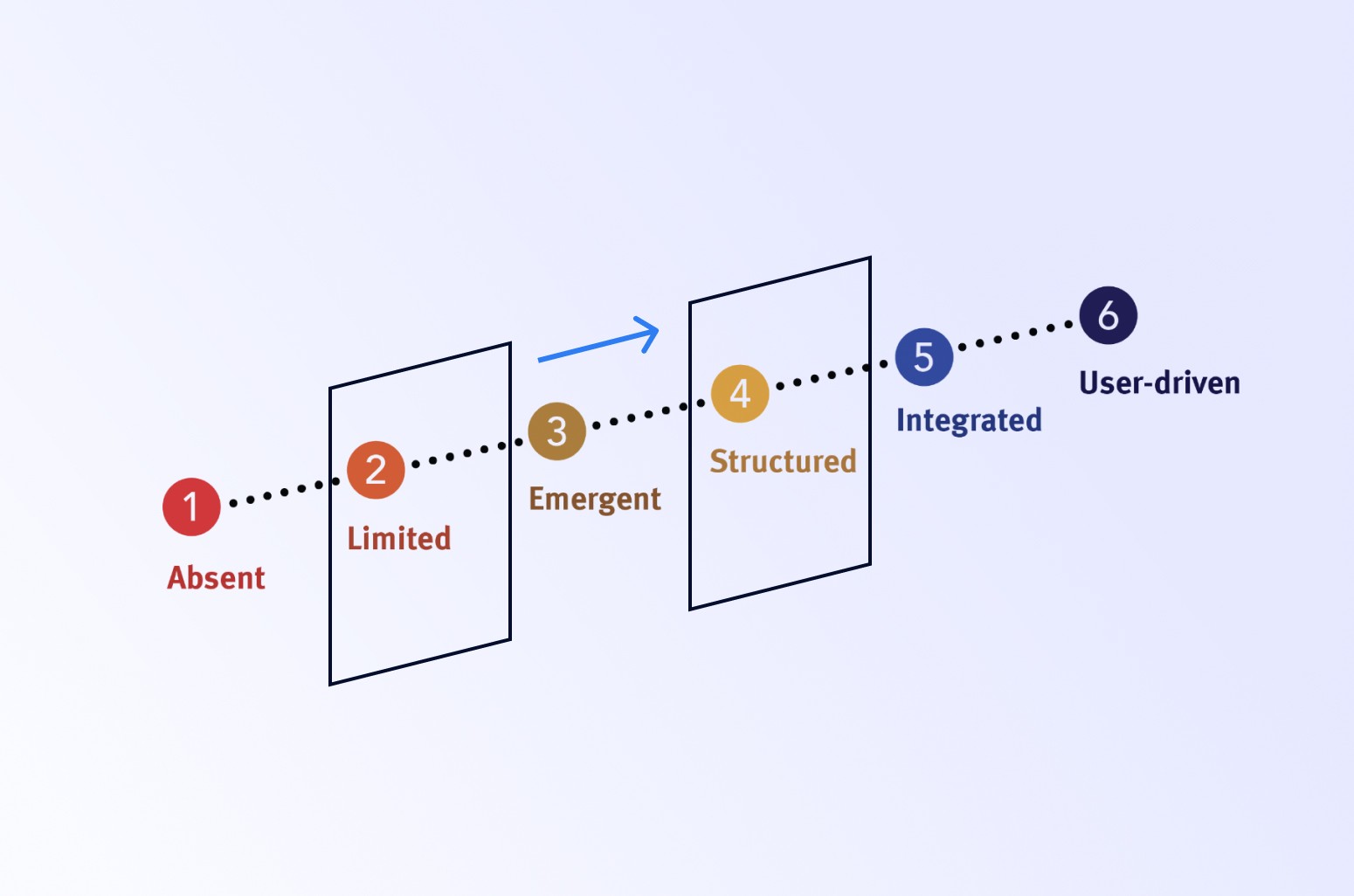
A variation on the NNM Group UX maturity model, the data consistently pointed towards #2 – Limited UX maturity, where there’s a growing awareness of UX and a desire to improve it, but with inconsistent processes and practices.
The challenge
How do you transform UX maturity across a mature, publishing-led business — one where the culture, processes, and leadership structures weren't built with design at the table?
This became one of my core long-term goals at Finder: define and execute a strategy that would shift the business toward greater UX maturity by driving systemic change through product, publishing, and design. The strategy had four pillars:
1. Driving customer centricity
Dedicated UXR function. Won the case for headcount and formed a UXR team (initially one person) to support evaluative and generative research, run discovery, and coach UI-leaning designers.
Key result → Changed the conversation from "build it and see" to "validate it first." Proved the business could test ideas before committing engineering resources.Research at Finder (RAF). Monthly company-wide brown-bag where design and UXR showed new research and — critically — connected insights to shipped outcomes.
Key result → A genuine success. Redefined what designers do in the minds of the wider business and sparked a culture of storytelling and insight-sharing.Democratising research. Centralised repository in Dovetail with insights, customer videos, and research summaries, accessible company-wide.
Key result → Mixed results. Mainly used by PDs and UXR, not the wider business. But the broader impact held: conversations about customers increased, awareness of design's capabilities grew, and the habit of connecting business goals to design outcomes took root.Fortnightly customer interviews. We established a regular cadence of customer interviews, ensuring stakeholders across the business were witnessing pain points firsthand. The rationale was simple: there's always something you should be showing customers or learning from them.
Key result → Went from zero user testing to a consistent two-week cadence. Research became a habit rather than a once a quarter “we should test this” scenario.
2. Transforming process and culture
With designers embedded in product squads, there was no consistent design or product process. The process needed to evolve first, then a cultural shift toward greater collaboration between the triad — engineering, design, and product management.
Design thinking workshops. We introduced workshops focused on customer empathy, collaborative ideation, and facilitation techniques — bringing cross-functional teams together to solve problems rather than working in silos.
Key result → Went from non-existent to regular occurrence. Previously, hours of eng and design time would be sunk into untested founder ideas. Workshops created space to pressure-test before committing.A radically candid feedback culture. I introduced the expectation of honest, constructive feedback across cross-functional teams and executive leaders — not just within design.
Key result → Harder to measure, but I led by example. Over time, psychological safety increased to the point where my own team were giving me direct, constructive feedback — which is how you know it's working.Defining the optimal product and design process. We articulated the foundational steps every project should follow. Not a rigid framework — there will always be variance between projects — but enough structure to clarify the role and value of design at each stage.
Key result → this reduced wasted time invested in bad ideas. It was about finding the sweet spot of "just enough process" to get the right results while still moving quickly.
3. Planning and strategy
When customer insights are helping inform strategy and planning, you've reached a high level of maturity. The priority was to ensure we had relevant research ready to inform decision-making — particularly ahead of planning cycles.
Generative research ahead of planning seasons and video highlight reels that made findings tangible for stakeholders who wouldn't read a full report.
Key result → The clearest proof point came from research we ran on Earn, a new feature within the consumer app (Finder's core cousmer-savings value proposition). Customer feedback on the crypto components was overwhelming — users felt it was diminishing trust in the product. This was 2021/22, just before the FTX collapse. The findings were shared as a report to executives and directly informed the decision to wind back crypto features from the app. A clear example of research shaping strategic direction.
4. Metrics and outcomes
Conversion metrics tell part of the story, but not the full picture. Implementing UX-specific measurement programs gave us visibility into user perceptions and pain points, informing where and how to improve.
Introduced the FXScore — a UX metric program that generated page-level scores based on both attitudinal and behavioural data.
Key result → Honestly, it didn't get much traction. The business wasn't ready to adopt a new measurement framework alongside everything else that was changing. It was also a compounded metric which meant nothing.Invested in Qualtrics XM to enable rapid quant surveying on our huge customer base
Key result → Impact exceeded expectations. Other teams adopted it independently, and it dramatically sped up our quantitative research capability.Overhauled our NPS program, to deliver more value to business units
Key result → NPS became a foundational metric used across the business to measure customer satisfaction.Pushed for UX metrics to be tied to product releases, so we were able to look at a blend of business and user success metrics.
Key result → We got there. The result was a clearer, more honest picture of real customer sentiment rather than pure business orientated conversion metrics.
Conclusion
Over the course of this work, Finder's UX maturity shifted from Limited to Structured. Product designers became genuine advocates for customers — grounded in real empathy, rather than assumptions, while balancing business goals. The top-down ‘design this’ approach shifted to, let’s jam on this problem. Product managers began running effective discovery research in partnership with design and UXR. And customer insights, prototyping, and rapid validation became part of how the business defines strategy.